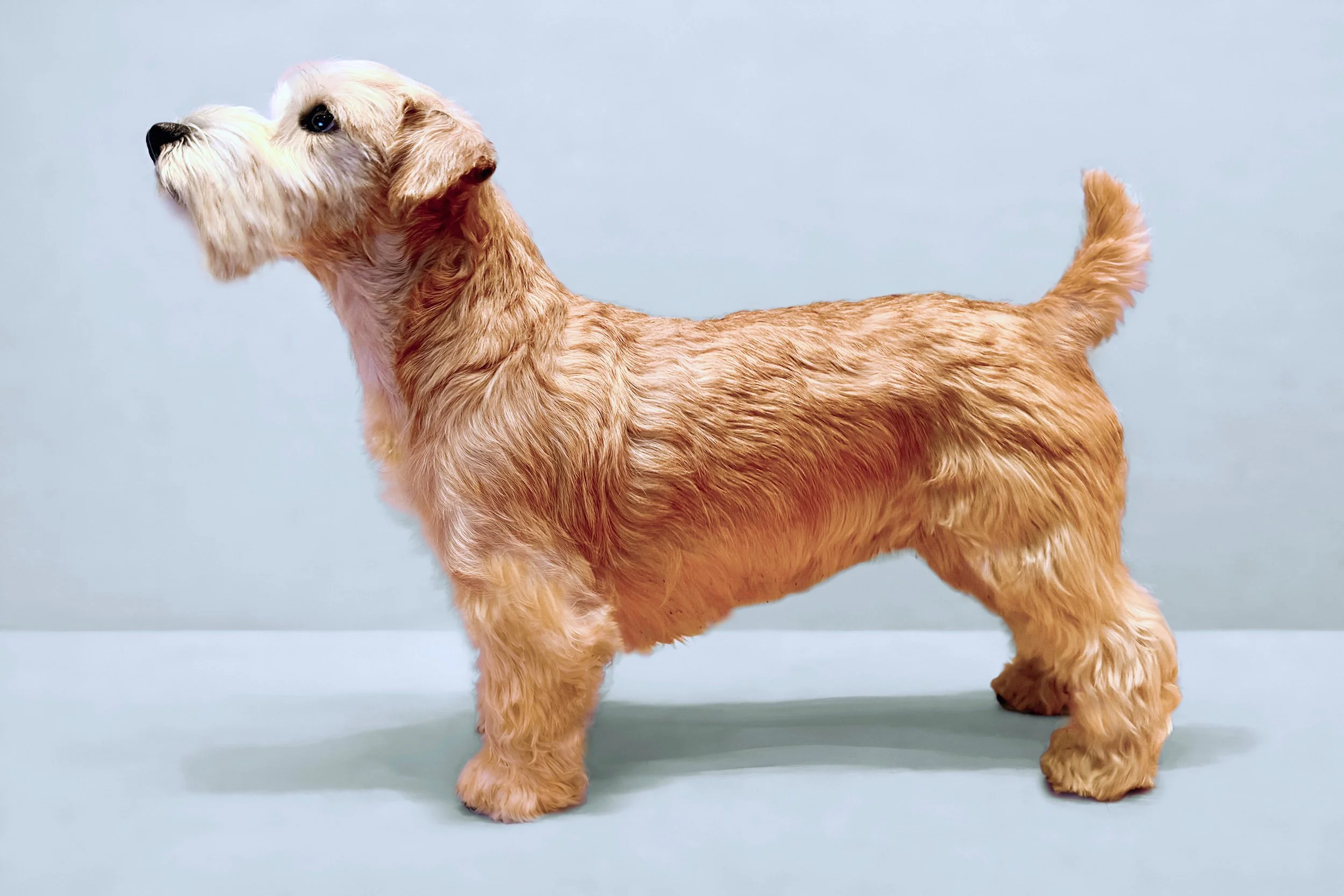
USLTA Announcement on AKC ACCEPTANCE of THE Lucas Terrier to FSS June 2026
At its May 2026 Board Meeting, the American Kennel Club (AKC) added the traditional Lucas Terrier to its Foundation Stock Service (FSS) Program, the result of a year of effort by The United States Lucas Terrier Association (USLTA) and its supporters.
What is the AKC's Foundation Stock Service?
The not-for-profit American Kennel Club, founded in 1884, is the oldest and largest purebred dog registry in the United States. Its Foundation Stock Service was created as a record-keeping and pedigree service for rare breeds not fully recognized by the AKC. FSS enables participation in many performance-related trials and events, which can further development and help to stabilize the dog’s breeding program. In some cases, it precedes AKC recognition. In other instances, it simply serves to protect and preserve a breed and its history. FSS recording of a dog does not guarantee or imply full AKC recognition. However, it provides the avenue to compete in Open Shows, Companion and Performance Events. There is no similar, corresponding program offered by the Royal Kennel Club (UK) at this time.
USLTA’s Goals for the Traditional Lucas Terrier
The nonprofit USLTA’s overall goal is to increase the population of healthy Lucas Terriers that exemplify the breed standard while ensuring the dogs lead fulfilling lives. To us, this means opportunity and access to activities that both Lucas Terriers and their owners enjoy, and whenever possible, reflect the breed’s original purpose. We believe the perfect companion is content, one that complements its family’s lifestyle, is a pleasure to be around and look at, and doesn’t spend all of its time at the vet.
The AKC is North America’s most prominent resource for dogs. USLTA recognizes the benefits of AKC’s Foundation Stock Service, and is enthusiastic about our collaboration.
Sir Jocelyn Lucas and the Breed's Original Purpose
Fortunately, the creator of the Lucas Terrier, Sir Jocelyn Lucas, in addition to being a respected hunter, was also a prolific writer and published author. As a result, we know a lot about what he wanted for the breed that bears his name.
A dedicated enthusiast and breeder of Sealyham Terriers at his renowned Ilmer Kennels, Lucas bred hundreds of terriers during his lifetime, which were distinctly different than the others of the day. While he showed dogs as well, Lucas’ concerns were also with health and function: dogs had to be small enough to perform the work historically ascribed to terriers and healthy enough to avoid whelping difficulties. In pursuit of this, he established an entirely new breed: the Lucas Terrier.
The original (traditional) Lucas Terrier is the product of an Ilmer Sealyham–Norfolk Terrier mating, with no other breeds introduced. Once type is successfully set, breeders move to Lucas-to-Lucas pairings — the model that now represents the preponderance of Lucas Terriers in the United States, all bearing direct descent from the UK and Ilmer.
Continuing the Tradition, Protecting the Breed
Myths have grown around Lucas’ presumed beliefs about the (now Royal) Kennel Club. The truth is that Lucas was a Kennel Club judge, and was primarily concerned with the size of the dogs, and with their health and well-being. The official breed standard for the Lucas Terrier will specifically address these concerns with an eye toward preventing any potential challenges that may arise in the breed’s later development.
Since the Lucas Terrier was first bred in the early part of the 20th century, much debate has been devoted to developing and setting type. Adherence to a dog’s official breed standard is critical in maintaining the integrity of a breed; we regard it as absolutely crucial to the Lucas Terrier’s foundational relationship with the American Kennel Club.
USLTA has fulfilled Lucas's vision with measurable success. Through a rigorous breeding program the traditional Lucas Terrier community has kept dogs well within Lucas's preferred size limits and avoided the exaggeration he feared (the U.S. Lucas Terrier population averages 12-14 lbs. for bitches; 15-17 lbs. for dogs). Even terriers not kept in proper weight rarely, if ever, exceed 9 kilos. The U.S. Lucas Terrier breeding program has avoided size exaggeration for years and managed to largely retain weatherproof coats (when appropriately handstripped), without outcrossing to other breeds.
The Association employs mandatory DNA health screening (written into the Association's bylaws and Code of Ethics) for every breeding Lucas Terrier for Primary Lens Luxation, Degenerative Myelopathy, and Intervertebral Disc Disease prior to any mating, and requires additional testing at the time of litter registration. USLTA does not accept results “by descent,” and monitors numerous disorders not yet identifiable by DNA methods as a matter of Association policy.
How the World Has Changed
Lucas, his kennel manager, the Hon. Mrs. Enid Plummer, and their successor Miss Anne "Jumbo" Frost, all had long-standing relationships with the (now Royal) Kennel Club, and operated in a 20th century British dog breeding world. The forces now bearing on the Lucas Terrier, and purebred dogs generally, are profound: the veterinary industry's strong push toward spay and neuter procedures (a practical death knell for any breeding program); animal rights policies affecting hunting culture; and the rise of the internet and artificial intelligence, which have dramatically amplified misinformation and marketing targeting dog owners – would scarcely be recognizable to them today.
The confusion between the traditional Lucas Terrier and the separately created, UKC-recognized ‘Sporting Lucas Terrier,’ a distinct breed developed in the 1990s, is one such example. Search engines and AI tools routinely conflate the two breeds (especially imagery), despite no intentional malice and repeated efforts to correct the record. The two are simply different dogs, but a potential owner in search of breed information soon finds themselves lost in a digital maze.
Why FSS, and Why Now?
Participation in the American Kennel Club’s Foundation Stock Service directly addresses many of the challenges that have been facing the original Lucas Terrier. It offers owners access to AKC sports and events without a mandatory spay-neuter requirement. It provides enhanced record-keeping and the improved visibility needed to combat breed confusion and misinformation. And it eliminates the "mutt" or "mongrel" sobriquet. After 75 plus years, we think it’s about time, and aligning with the AKC is the right way, to meet the realities of the 21st century.